
Key Takeaways
- Restaurant websites and mobile apps are now direct revenue channels, not just digital brochures.
- Direct ordering helps restaurants reduce third-party commission costs and keep full control of the customer relationship.
- A strong online ordering system should support menus, payments, delivery workflows, customer data ownership, and integrations.
- Mobile apps increase repeat orders through saved favorites, loyalty rewards, push notifications, and faster checkout.
- Restolabs helps restaurants launch commission-free online ordering quickly — with expert setup, flexible plans, no long-term contracts, and the ability to start selling online in as little as one day.
When a guest searches for dinner, the restaurant has a narrow window to win the order. If the experience feels slow, outdated, or routed through a third-party app, that sale can come with lost margin and little customer insight.
For restaurant owners, that moment matters because the ordering channel shapes the economics of the sale. A marketplace order may bring visibility, but it can also take a commission and keep the customer relationship at arm's length.
A restaurant-owned website or mobile app changes that equation. Guests still get the convenience they expect, while the restaurant keeps more control over revenue, customer data, and repeat engagement.
What Is a Restaurant Mobile App Ordering System?
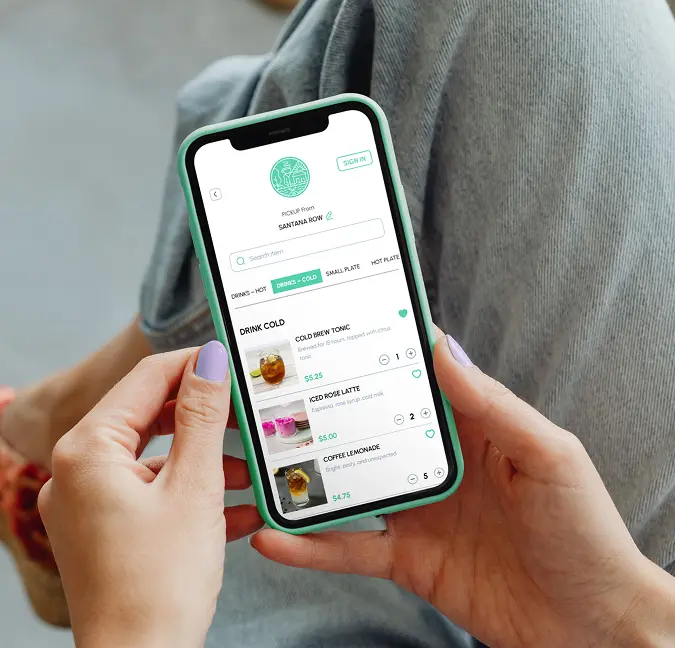
A restaurant mobile app ordering system is a branded digital platform that lets guests browse menus, customize items, pay securely, and choose pickup or delivery — all from their phone, without leaving the restaurant's own ecosystem.
A restaurant mobile app is a branded digital tool that gives guests a direct way to browse menus, place orders, make reservations, earn loyalty rewards, and track deliveries — all without leaving the restaurant's own ecosystem.
It is worth distinguishing between three types of digital ordering channels. A restaurant website supports discovery and SEO — guests find it through search. A third-party marketplace app like a food delivery platform brings visibility but charges a commission on every order. A restaurant-owned mobile app is the only channel where the restaurant controls the brand, owns the customer data, and keeps the full margin.
For independent restaurants and growing multi-location brands, the question is not whether they need more technology. It is whether the technology can pay for itself without adding another complicated contract or commission model.
For operators evaluating branded mobile apps for restaurants, the distinction is significant. Owning the ordering channel means owning the relationship.
How Restaurant Mobile App Ordering Works
Understanding the end-to-end flow helps operators see exactly where the value is created — and where traditional phone ordering loses ground.
- Guest opens the branded app on Android or iOS and browses the current menu with photos and descriptions.
- Guest customizes items using structured modifier options — no phone calls, no miscommunication.
- Guest selects pickup or delivery, schedules a time, and applies any loyalty rewards or promo codes.
- Guest pays securely using a saved card, digital wallet, or new payment method — checkout in seconds.
- Order routes instantly to the kitchen or POS system, timestamped and pre-formatted — no staff transcription required.
- Guest receives confirmation and live tracking updates via push notification or SMS.
- Restaurant reviews order data post-fulfillment — order volume, revenue, popular items, and customer behavior — all in one dashboard.
Every step happens within the restaurant's own channel. No marketplace sitting in the middle. No commission deducted per transaction. No customer data handed to a third party.
Why Restaurants Need Websites and Mobile Apps for Direct Ordering
A restaurant website used to be a digital brochure. Guests checked the menu, looked up the address, and maybe called to place an order.
That has changed. A modern restaurant website or mobile app now functions as a direct online ordering channel — accepting orders, processing payments, and capturing customer data without sending every transaction through a commission-heavy marketplace.
Guests now discover restaurants online before they ever walk through the door. For operators, that means the website and mobile app need to do more than look polished. They need to help convert interest into direct orders.
What guests expect from a restaurant website in 2026 is straightforward: accurate menus, clear prices, easy ordering, secure payment options, and pickup or delivery details that are simple to find. Restaurants that meet that expectation capture the order. Those that fall short send the guest elsewhere — often to a platform that charges a commission for the privilege.
Benefits of Restaurant Mobile App Ordering
Convenience is only part of the reason restaurant-owned apps matter. When repeat guests order through a branded app instead of a marketplace, the restaurant keeps the margin, the data, and the next opportunity to bring that customer back.
- Direct ordering without commission fees: Every order placed through a branded app stays within the restaurant's revenue stream.
- Higher average order value: In-app upsells, add-ons, and combo suggestions are easier to present digitally than over the phone.
- Repeat purchases through saved preferences: Guests can reorder a favorite meal in a few taps, removing friction from the repeat visit.
- Customer data ownership: The restaurant sees who is ordering, how often, and what they prefer — data that supports smarter loyalty and marketing decisions.
- Push notifications that drive traffic: A well-timed message about a new menu item or a limited-time offer can convert idle attention into an order.
- Faster checkout: Saved payment methods and order history make the checkout experience noticeably quicker than starting from scratch each time.
- Reduced phone-order pressure on staff: Digital orders arrive structured and complete, removing the need for staff to manually take and transcribe orders during peak hours.
- Stronger brand visibility: A restaurant's own app sits on the customer's device — a persistent presence that third-party platforms do not offer.
How Direct Ordering Protects Restaurant Margins
Third-party marketplaces can help with discovery, but they often take a meaningful share of every order. For restaurants already working with tight margins, that trade-off becomes harder to ignore as online volume grows.
A direct ordering website or mobile app gives the restaurant a different path. Guests still get the convenience of ordering online. The restaurant keeps more of the revenue and owns the customer relationship. Use the commission savings calculator to see exactly how much third-party fees may be costing the business each month.
Commission-free ordering is not just a cost reduction — it is a structural change in how the restaurant captures revenue from digital traffic.
Platforms like Restolabs are built for that shift: direct online ordering, integrated payments, delivery workflows, and customer data ownership without per-order commissions.
Ready to take direct orders without commission fees?


.svg)
How Restaurant Mobile App Ordering Increases Sales
Picture the Friday dinner rush. The phone keeps ringing, staff are juggling walk-ins, and a regular customer wants to reorder the same meal without waiting in line.
A branded mobile app turns that moment into a direct order. The customer taps through their saved favorites, pays with a stored card, and the order goes straight to the kitchen — structured, complete, and requiring no staff intervention to capture.
The revenue mechanisms behind mobile app restaurant ordering compound over time. Saved preferences make repeat ordering faster. Personalized push notifications bring guests back during slow periods. Loyalty rewards create a reason to choose the restaurant's own app over a third-party platform. Each of these touchpoints adds to order frequency without requiring additional marketing spend.
Operational Benefits: Faster Orders, Fewer Errors, and Better Rush-Hour Flow
The operational case for restaurant apps is as strong as the revenue case. Phone orders require a staff member to be available, listen carefully, and accurately capture customization requests under pressure. Digital orders arrive pre-formatted, timestamped, and ready to route to the kitchen.
During peak hours, that difference matters. A restaurant handling 40 digital orders during a Friday evening rush is freeing its team to focus on food quality and in-person service — not fielding calls and reading back order confirmations. Fewer errors. Less rework. Faster table turns.
Apps also standardize customization requests, which reduces kitchen confusion. When a guest specifies "no onions, extra sauce" through a structured digital form, the instruction arrives clearly — not paraphrased by whoever answered the phone.
Beyond order accuracy, the operational stack extends further. Orders can trigger automatic kitchen printing, route to specific prep stations based on item type, and sync with POS systems in real time. Staff receive instant notifications on tablets or terminals. Out-of-stock items can be marked unavailable in seconds, preventing guests from ordering items the kitchen cannot fulfill. Service can be paused during unexpected rushes or closures — without a phone call, without confusion.
How Mobile Apps Strengthen Customer Loyalty and Repeat Orders
Loyalty is not built on a single great meal. It is built on consistent, convenient experiences that give guests a reason to return — and a frictionless way to do it.
A branded restaurant app supports loyalty in ways that a website alone cannot. Reward points accumulate automatically with each order. Birthday offers arrive as push notifications rather than generic email blasts. App-exclusive discounts create a sense of value for guests who choose the direct channel. And a one-tap reorder button removes the biggest barrier to a repeat purchase: starting the process over from scratch.
When customers order directly, the restaurant gains more than a transaction. It gains insight into ordering habits, preferred items, peak ordering times, and customer lifetime value — data that third-party platforms keep to themselves. Direct online ordering brings that data back to the restaurant, where it can inform smarter loyalty campaigns and better menu decisions.
Restaurant Mobile App vs Restaurant Website: Which Do You Need?
The honest answer is: most restaurants benefit from both, but they serve different purposes in the customer journey.
Comparison of restaurant website, mobile app, and third-party marketplace for direct ordering
A branded website attracts guests who are searching for a place to eat. A mobile app retains them. Used together through a single integrated platform, both channels compound each other's value without adding operational complexity.
Do You Still Need Your Own App If You Use Third-Party Delivery Apps?
Third-party platforms like DoorDash and Uber Eats do something valuable: they put the restaurant in front of new customers. But discovery and retention are different problems — and marketplaces are only built to solve the first one.
Once a guest has ordered once, the marketplace has no incentive to send them back to that specific restaurant. The repeat order could go to a competitor listed right below. The restaurant paid a commission, fed the customer, and never got the chance to build a relationship.
A restaurant-owned mobile app solves the retention half of that equation. Loyalty points, push notifications, saved favorites, and direct checkout give returning guests a clear reason to skip the marketplace entirely. That shift — even moving 30% of repeat orders to a direct channel — can meaningfully reduce commission exposure and increase margin on the same customer base.
The short answer: third-party apps for discovery, owned apps for retention. Most operators who understand their unit economics use both — with the goal of gradually shifting loyal customers toward the direct channel over time.
How Much Does a Restaurant Mobile App Cost?
Cost is often the first question operators ask — and the most inconsistently answered. Restaurant mobile app pricing spans a wide range depending on the model, and understanding the differences helps avoid expensive surprises.
For most independent restaurants and growing brands, a flat monthly subscription with no per-order commissions delivers the clearest return. The math is simple: if the platform costs $99 per month and the restaurant shifts even 50 additional direct orders at $30 average order value — avoiding a 20% marketplace commission — the savings cover the platform cost several times over.
Free vs Paid Restaurant Ordering Apps: What Should You Choose?
Free tools can be a reasonable starting point — but they rarely stay free once a restaurant starts scaling. Here is what the comparison actually looks like across the criteria that matter most to operators.
A free plan makes sense for testing before committing. But for any restaurant that depends on repeat orders, customer loyalty, or multi-location consistency, the limitations of a free system quickly outweigh the $0 monthly cost.
Essential Features of a Restaurant Mobile App Ordering System
Not all restaurant apps are built equally. The difference often shows up when a Friday night rush hits — and the platform can't update an out-of-stock item, push an order to the kitchen, or process a loyalty redemption without staff intervention.
- ✅ Online ordering with real-time menu updates
- ✅ Digital menus with item photos, descriptions, and modifiers
- ✅ Secure payment processing (cards, digital wallets)
- ✅ Order tracking for delivery and pickup
- ✅ Loyalty program with points, rewards, and tiered offers
- ✅ Push notifications for promotions and order updates
- ✅ Customer profiles with saved preferences and order history
- ✅ Coupons and app-exclusive discounts
- ✅ Delivery and pickup scheduling
- ✅ POS and delivery integrations
- ✅ Analytics dashboard showing order volume, revenue, and customer behavior
- ✅ Customer data ownership — not locked into the platform provider
- ✅ Android and iOS native apps — available in both Google Play and Apple App Store
- ✅ Real-time out-of-stock controls — mark items unavailable instantly without menu rebuilds
- ✅ Service pause controls — stop accepting orders during closures or unexpected rushes
- ✅ Kitchen printing and order routing — auto-route orders to the right prep station
Restaurant Order Mobile App for Android and iOS
Cross-platform availability is not optional — it is a baseline requirement. Guests do not switch phones to match a restaurant's app preferences, and staff should not be limited to a single device type for order management.
A restaurant mobile app ordering system should be available in both the Apple App Store and Google Play, ensuring every customer — regardless of device — can download, order, and engage with the restaurant's loyalty program. On the operations side, staff should be able to manage incoming orders, update availability, and monitor the dashboard from any tablet or smartphone, whether it runs iOS or Android.
Push notifications, a key retention tool, function consistently across both platforms when the app is properly published. Web-only ordering tools cannot deliver the same notification reliability — which is one of the functional gaps that makes a native app worth the investment for restaurants that rely on repeat ordering.
How to Choose the Right Restaurant Mobile App
Choosing a restaurant app platform is a business decision, not just a technology one. The right framework helps operators avoid costly mistakes — including locking into a platform that takes commissions, limits integrations, or owns the customer data.
A better evaluation starts with the moments that already create friction: missed phone orders, slow checkout, disconnected delivery workflows, or customers who keep returning through third-party apps instead of direct channels.
- Define operational needs first. Is the priority faster ordering, fewer phone calls, loyalty, delivery routing, or all of the above?
- Confirm commission structure. Restaurant-owned apps should not charge a percentage of each order. If they do, calculate the long-term cost against the margin.
- Check integration requirements. Does the platform connect with the existing POS, payment processor, and delivery providers?
- Verify customer data ownership. The restaurant — not the platform — should own and be able to export customer records.
- Review setup and ongoing costs. Transparent, flat-rate pricing is easier to plan around than usage-based fees.
- Assess support quality. Expert onboarding and accessible support reduce launch friction significantly.
- Test the guest experience. Order something through the demo environment. If it feels slow or confusing to a first-time user, guests will notice too.
- Evaluate scalability. The platform should support the restaurant's current size and its growth trajectory — whether that means one location or twenty.
- Confirm Android and iOS availability. The app should be publishable to both major app stores for full customer reach.
- Check free-plan limitations. If evaluating a free tier, confirm which features are restricted and what transaction fees apply at scale.
How a Direct Ordering Platform Helps Restaurants Launch Faster
For operators who do not want another marketplace sitting between them and their guests, Restolabs offers a more direct path. Restaurants can share menus, accept payments, connect key systems, and start selling online quickly without commissions or long-term contracts shaping every order.
Menu sharing also helps restaurants turn existing menu assets into a direct ordering experience faster, reducing the manual work usually tied to launching a new digital channel.
That speed matters because launch friction often kills momentum. Restolabs supports setup across menus, modifiers, payments, delivery rules, and integrations, so restaurants are not left stitching together a digital ordering workflow on their own.
For multi-location operators, that control becomes even more important. Menu updates, ordering rules, delivery zones, loyalty campaigns, and reporting need to stay consistent without forcing every location into a separate workflow.
The platform supports POS integrations, delivery management, loyalty tools, and real-time analytics — all accessible from a single dashboard. Restaurants that want to accept orders through their own branded channel can explore direct online ordering, a branded website, and a branded mobile app to create a smoother, more profitable guest experience.
Restolabs also supports setup, so operators are not left translating menus, modifiers, taxes, delivery rules, and payment settings on their own. That expert guidance matters most when a restaurant wants speed without sacrificing accuracy.
Flexible, contract-free plans also reduce the risk for operators who want to move away from commission-heavy platforms without committing to an expensive, rigid system before seeing results.
Fast setup, no commissions, flexible plans, and full customer data ownership. That is the foundation Restolabs is built on — and the reason operators choose it over platforms that monetize every order placed through their system.
How to Launch a Mobile App for Your Restaurant
Getting online ordering live should not require months of custom development. With Restolabs, restaurants can start selling online in as little as one day, then expand into branded websites, mobile apps, loyalty, and delivery workflows as the business grows.
- Define goals: Clarify whether the priority is direct ordering, loyalty, delivery, or a combination.
- Choose features: Select the capabilities that match current operational needs, with room to expand.
- Prepare menu and branding: Upload menu items, photos, descriptions, and pricing. Apply brand colors and logo.
- Configure ordering rules: Set pickup and delivery zones, hours, minimum orders, and special instructions handling.
- Connect payments: Integrate with the preferred payment processor and test the checkout flow.
- Train staff: Ensure the team knows how digital orders arrive, how to manage them, and how to handle exceptions.
- Test the workflow: Place test orders across device types — including both Android and iOS — before going live.
- Promote the app: Share the app link on social channels, in-store signage, and through email to existing customers.
- Measure performance: Track app downloads, order volume, average order value, and repeat order rate from launch.
Suggested launch timeline: Day 1 — online ordering live with menu and payment setup. Days 2–3 — configure integrations, delivery zones, and ordering rules. Days 4–5 — staff training and test orders. Launch week — promote through in-store, social, and email channels. Week 2 — review first performance metrics and adjust.
Common Problems With Mobile Ordering Apps and How to Avoid Them
Most mobile ordering failures are not technology problems — they are configuration and adoption problems. The app works; the setup did not account for real-world friction.
How to Measure ROI from a Restaurant Mobile App
Investment in a restaurant app should show up in the numbers — not just in impressions or app downloads. The metrics below connect directly to margin protection, customer retention, and direct revenue. If these are not moving in the right direction after 60 days, they point to exactly where the fix needs to happen.
Example ROI calculation: A restaurant shifts 200 monthly orders from a third-party platform (charging 20% commission) to a direct app. At an average order value of $35, that represents $7,000 in monthly order volume. The avoided commission is $1,400. If the platform costs $99 per month, the net monthly saving is approximately $1,301 — before accounting for any increase in average order value or repeat order frequency from loyalty features.
For restaurant operators, the opportunity is clear: every direct order is more than a transaction. It is margin protected, customer data retained, and another chance to bring that guest back without paying a marketplace to reach them again.
Book a Demo to see how Restolabs helps restaurants launch commission-free direct ordering.

Team Restolabs is a group of hospitality tech experts, strategists, and innovators dedicated to helping restaurants thrive in the digital age. With deep expertise in branding, growth, product development, and restaurant technology, we provide insights on scaling, streamlining operations, and enhancing customer experience.
Frequently Asked Questions
Mobile apps for restaurants are branded digital tools that allow guests to browse menus, place orders, pay securely, track deliveries, and earn loyalty rewards — all through the restaurant's own channel. Unlike third-party marketplace apps, a restaurant-owned mobile app keeps the full margin and customer data with the business.
The main benefits include commission-free direct ordering, higher average order value through in-app upsells, improved customer retention through loyalty programs, push notification marketing, full customer data ownership, reduced staff workload during peak hours, and faster repeat ordering through saved preferences.
A restaurant mobile app increases sales by removing friction from repeat purchases, enabling in-app upsells and add-ons, driving return visits through push notifications and loyalty rewards, and reducing order errors that lead to refunds. Digital orders also tend to have a higher average value than phone orders because guests have more time to consider the full menu.
A restaurant mobile app should include online ordering, digital menus with modifiers, secure payment processing, order tracking, loyalty programs, push notifications, customer profiles with saved order history, delivery and pickup scheduling, POS integrations, and an analytics dashboard. Customer data ownership is a non-negotiable requirement.
They serve different purposes. A restaurant website is stronger for discovery and SEO — helping new guests find the restaurant through search. A mobile app is stronger for repeat ordering, loyalty, and direct engagement with existing customers. Most operators benefit from using both together through an integrated platform.
A mobile app can benefit restaurants of any size, but the value depends on order volume and guest return rate. For small restaurants with a loyal local customer base, a branded app can meaningfully reduce commission dependency and strengthen repeat ordering. Platforms like Restolabs offer flexible plans that make mobile ordering accessible without enterprise-level investment.
Key ROI metrics include app downloads, repeat order rate, average order value, commission savings from shifting orders off third-party platforms, push campaign revenue, and loyalty redemption rate. Tracking these over time shows whether the direct channel is growing and where improvements will have the most impact.



.jpeg)





.webp)

.svg)
.webp)