
Key Takeaways
- Not every restaurant loyalty program works for every business. The best model depends on how often your customers order, what they typically spend, and the behavior you want to encourage.
- The five most common loyalty models are points-based, visit-based, cashback, subscription, and tiered programs, each with different advantages and trade-offs.
- Customers should be able to earn their first meaningful reward within a realistic timeframe. If it takes too long, participation usually drops.
- Design rewards around high customer value and low restaurant cost to keep your program attractive without hurting margins.
- Track repeat orders, direct ordering, redemption rates, and reward costs to measure whether your loyalty program is actually increasing customer retention and profitability.
Winning a customer’s first order is difficult. Getting them to come back is even harder.
A customer might love your food today, but by the time they’re ready to order again, they’re choosing between dozens of restaurants competing for their attention. Without a compelling reason to return, even satisfied customers can quickly become occasional customers.
That’s where a restaurant loyalty program can make a difference.
A well-designed loyalty program gives customers an extra reason to choose your restaurant again. It can encourage repeat visits, increase direct online orders, grow customer lifetime value, and strengthen long-term relationships. But not every loyalty program delivers those results.
The most successful programs are easy to understand, offer rewards customers can realistically earn, and encourage the behaviors that matter most to your business.
According to Circana’s 2025 restaurant loyalty research, loyalty members now account for 39% of restaurant visits, while loyalty traffic has doubled since 2019. However, simply launching a loyalty program isn’t enough. The way you design it has a direct impact on whether customers participate or ignore it altogether.
In this guide, you’ll learn:
- The different types of restaurant loyalty programs and when to use each
- Real-world examples from successful restaurant brands
- How to choose rewards customers actually value
- How to calculate whether your program is profitable
- How to launch, promote, and optimize your loyalty program
- How to integrate loyalty with your direct online ordering platform
Let’s get started.
What Is a Restaurant Loyalty Program?
A restaurant loyalty program is a structured retention strategy that allows you to recognize returning customers for repeat purchases and engagement, giving them access to benefits that occasional or one-time diners don’t receive.
How do restaurant loyalty programs work?
Customers first enroll in the program using an identifier such as a phone number, email address, QR code, or membership ID. This allows the restaurant to connect each individual account with various qualifying activities, such as:
- Placing an order
- Reaching a spending threshold
- Completing a set number of visits
- Paying for access to recurring benefits
- Ordering through the restaurant’s website or app
Depending on the action, customers may collect points, build visit credit, progress toward a spending target, or unlock a member benefit. When the required conditions are met, the corresponding reward becomes available to them.
And once it’s used, the program records the redemption and updates the account before tracking the next eligible order placed by the customer.
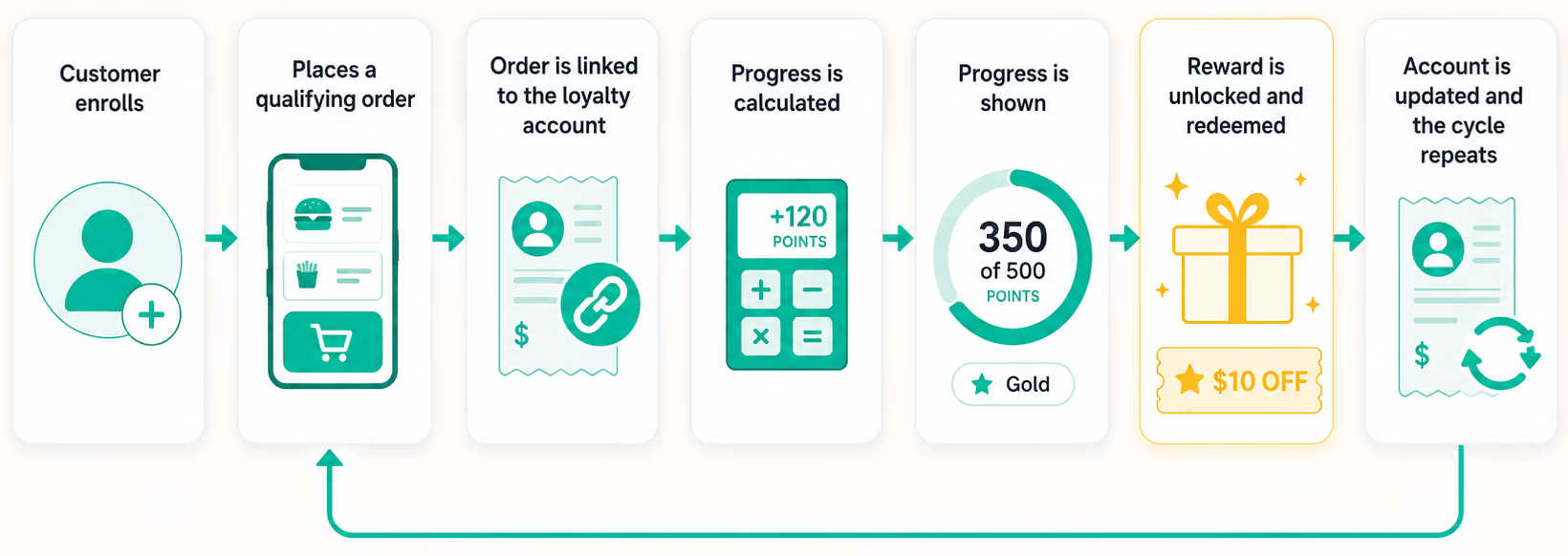
Components of restaurant loyalty programs
Every program comprises five core elements:
Types and Examples of Best Restaurant Loyalty Programs
If you look at the loyalty programs offered by restaurants today, you’ll find a wide range, from simple punch cards to app-based systems with multiple reward layers. However, most fall into a handful of core models.
Let’s explore what each one allows you to do:
1. Points-based loyalty programs
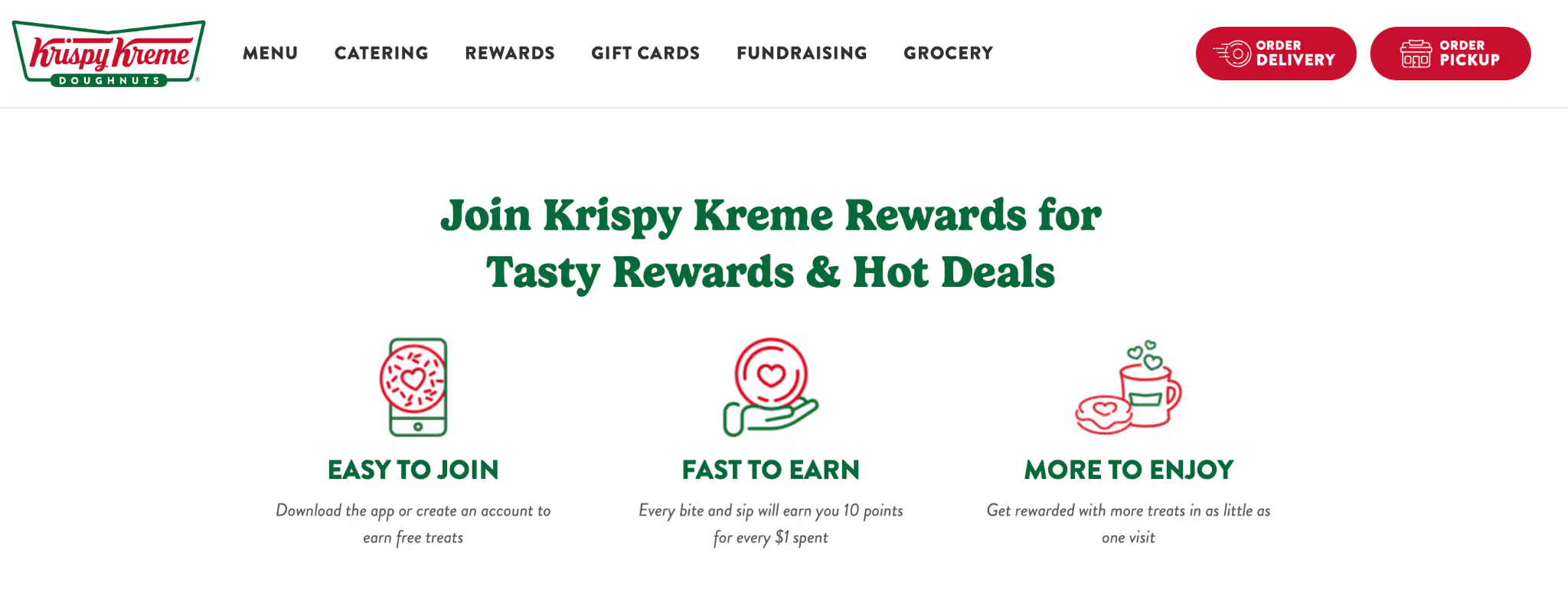
In this model, customers earn points based on how much they spend with you. Once they reach a set total, they become eligible to redeem it for an incentive like a free item or a discount. Take Krispy Kreme Rewards as an example.
It currently awards 10 points for every $1 spent:
- A $6 order earns 60 points
- A $20 order earns 200 points
- A $60 order earns 600 points
So, if a free menu item costs 500 points, a customer who spends $60 unlocks it after one order, whereas someone who spends $20 per order reaches it after three. Krispy Kreme loyalty members can then trade their points for several specific rewards as shown below:
2. Frequency-based loyalty programs
This type of loyalty program counts how many times a customer completes the qualifying action you’ve defined, such as buying a particular dish or visiting your restaurant. After they reach the required number, they receive the reward.
For example, if your offer is “buy nine coffees, get the tenth free,” each eligible coffee adds one credit to the individual account:
- First coffee: 1 of 9
- Fifth coffee: 5 of 9
- Ninth coffee: Reward unlocked
Here, the amount spent doesn’t change the customer’s progress. A $4 coffee and a $7 coffee each earn one credit, for a total of two credits.
This simplicity is the appeal of frequency-based loyalty programs, and they work best when customers regularly return for the same type of order, such as coffee, lunch, smoothies, or pizza.
99 Restaurants counts every dine-in visit and every direct online order of at least $9.99 toward its visit-based rewards program. Members get a surprise gift after every third visit.
3. Cashback or credit-based loyalty programs
Unlike points, cashback tells customers exactly how much value they’ve earned – you return a fixed percentage of each qualifying transaction as restaurant credit. Let’s assume you offer 10% back on specific orders. That means:
- A $20 order earns $2 in credit
- A $50 order earns $5 in credit
- A $90 order earns $9 in credit
The customer can apply that credit directly to a later order. The decisions for credit-based restaurant loyalty programs that matter are on your side:
- Whether the full balance can be redeemed at once
- Whether a minimum order applies
- How long the credit stays valid
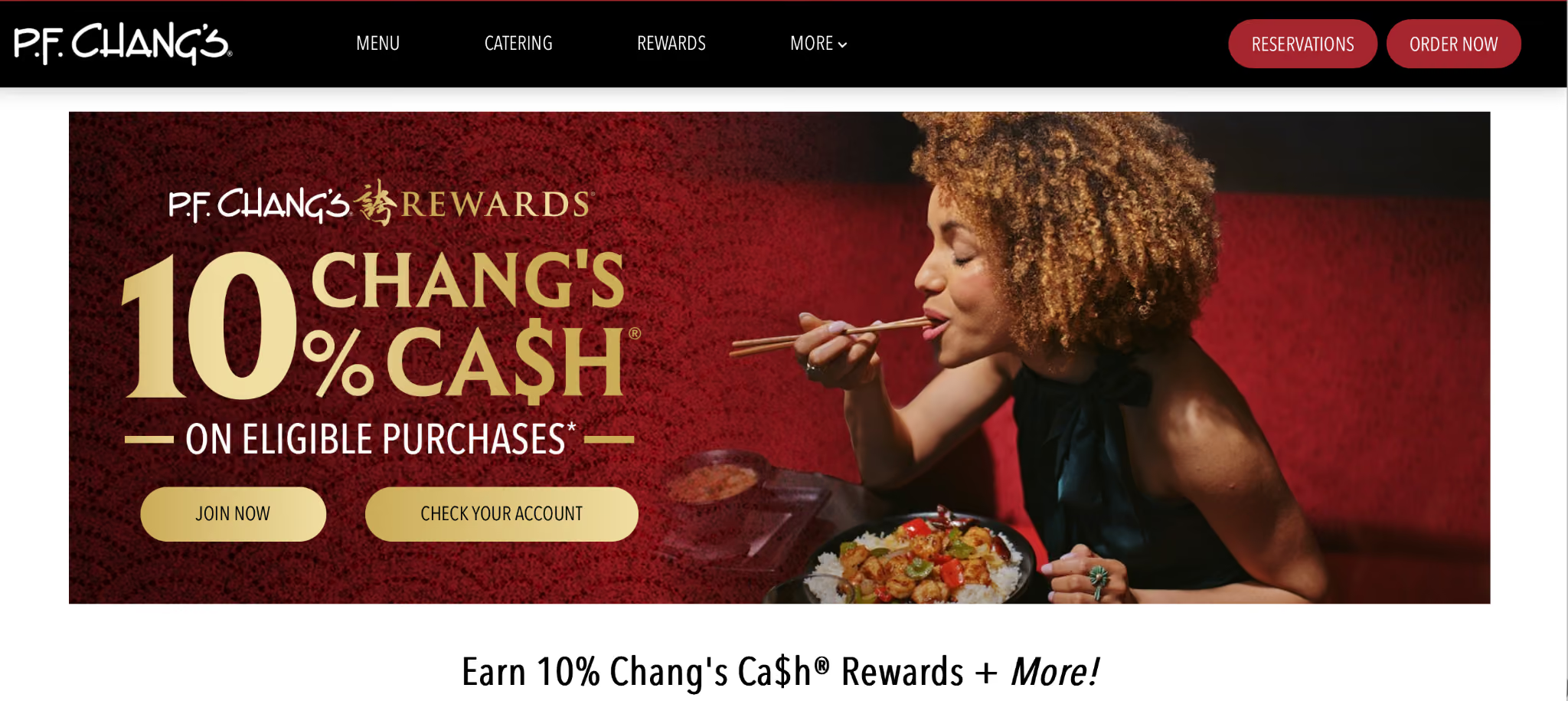
At P.F. Chang’s, for instance, members earn 10% back in Chang’s Ca$h on eligible spending on food and non-alcoholic beverages. An $80 order therefore adds $8 in credit to their account for further use.
4. Paid subscription loyalty programs
This model enables you to charge customers a monthly or annual fee in exchange for benefits they can use throughout that period. These may include selected menu items, member pricing, free delivery, or other recurring perks.
Here, customers don’t need to place a certain number of orders or build a reward balance. Once they pay the subscription fee, the included benefit becomes available to them according to the program’s usage rules.
For example, Panera’s Unlimited Sip Club charges members $14.99 per month and allows them to redeem an eligible beverage once every two hours during normal café hours.
Panera uses an average price of $3.99 for a large eligible beverage when illustrating the potential value of the membership:
- 1 beverage would ordinarily cost $3.99
- 4 beverages would ordinarily cost $15.96
- 10 beverages would ordinarily cost $39.90
In that comparison, a customer who redeems four eligible beverages during the month has already received more than the $14.99 subscription fee in menu value. The more often they use the benefit after that, the more valuable the membership feels.
5. Tiered loyalty programs
These programs divide customers into membership levels. Everyone typically starts in the first tier, and customers move into higher tiers after meeting a defined threshold, which could be based on:
- Points earned
- Total spending
- Number of visits made
- Number of orders placed
Each higher tier should offer noticeably better benefits, such as a faster reward-earning rate, larger birthday rewards, exclusive menu items, or free delivery.
In addition, you must decide how long each status lasts – customers may keep their tier permanently, retain it for one year, or need to qualify again during every membership period.
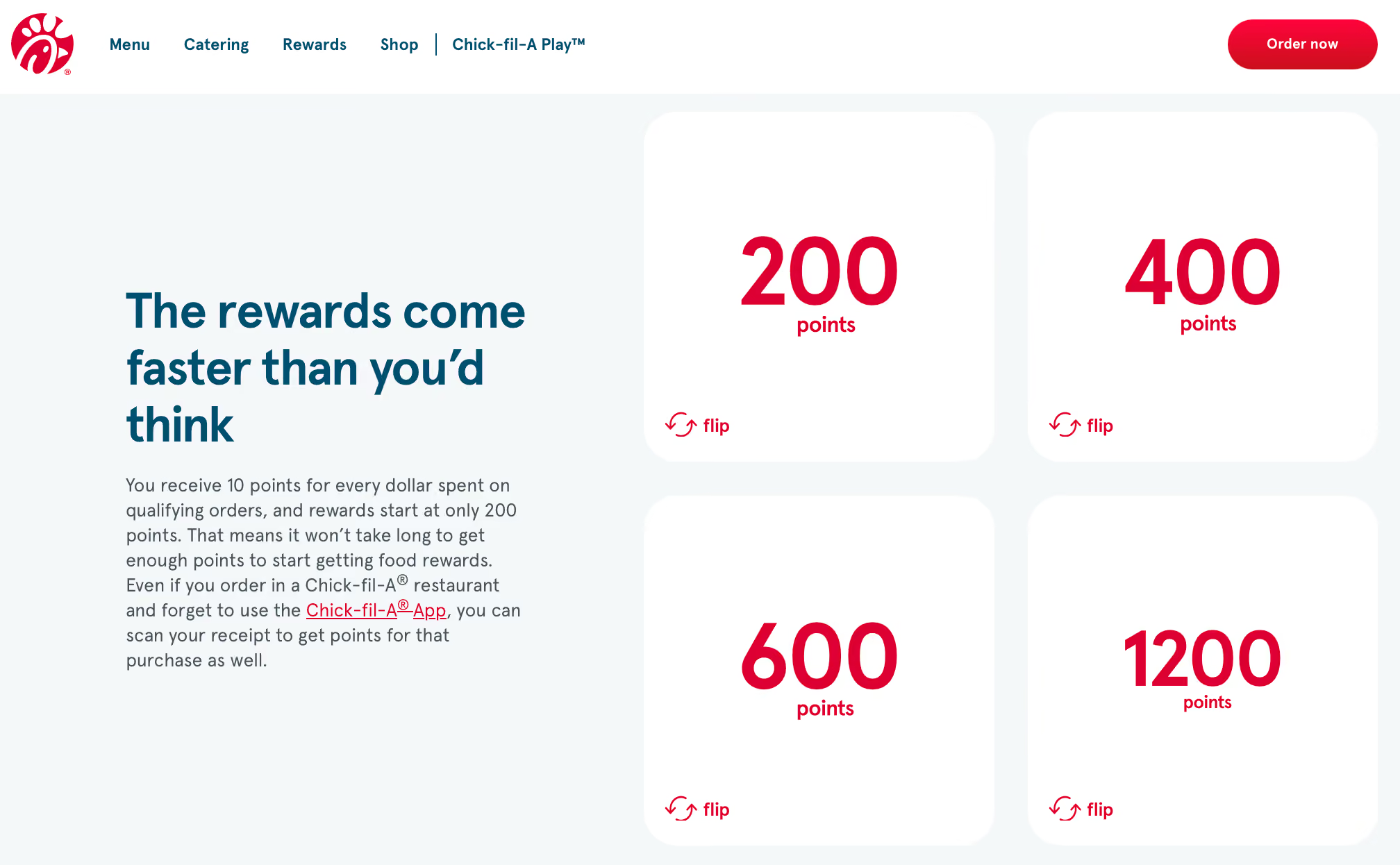
Chick-fil-A One is an example of a tiered points program. A member’s status is determined by the number of points earned during the calendar year:
- Member: The base tier, where customers earn 10 points per $1 spent.
- Silver Member: Unlocked at 1,000 points. Customers earn 11 points per $1 and can use their points to gift rewards to friends and family.
- Red Member: Unlocked at 4,000 points. Customers earn 12 points per $1 and receive additional benefits, including access to a complimentary Chick-fil-A Backstage Tour.
- Signature Member: Unlocked at 10,000 points. Customers earn 13 points per $1 and gain access to rewards reserved for Signature members.
Tiered programs work best when you have enough frequent or high-spending customers to separate into meaningful groups.
How To Choose The Right Loyalty Program For Your Restaurant
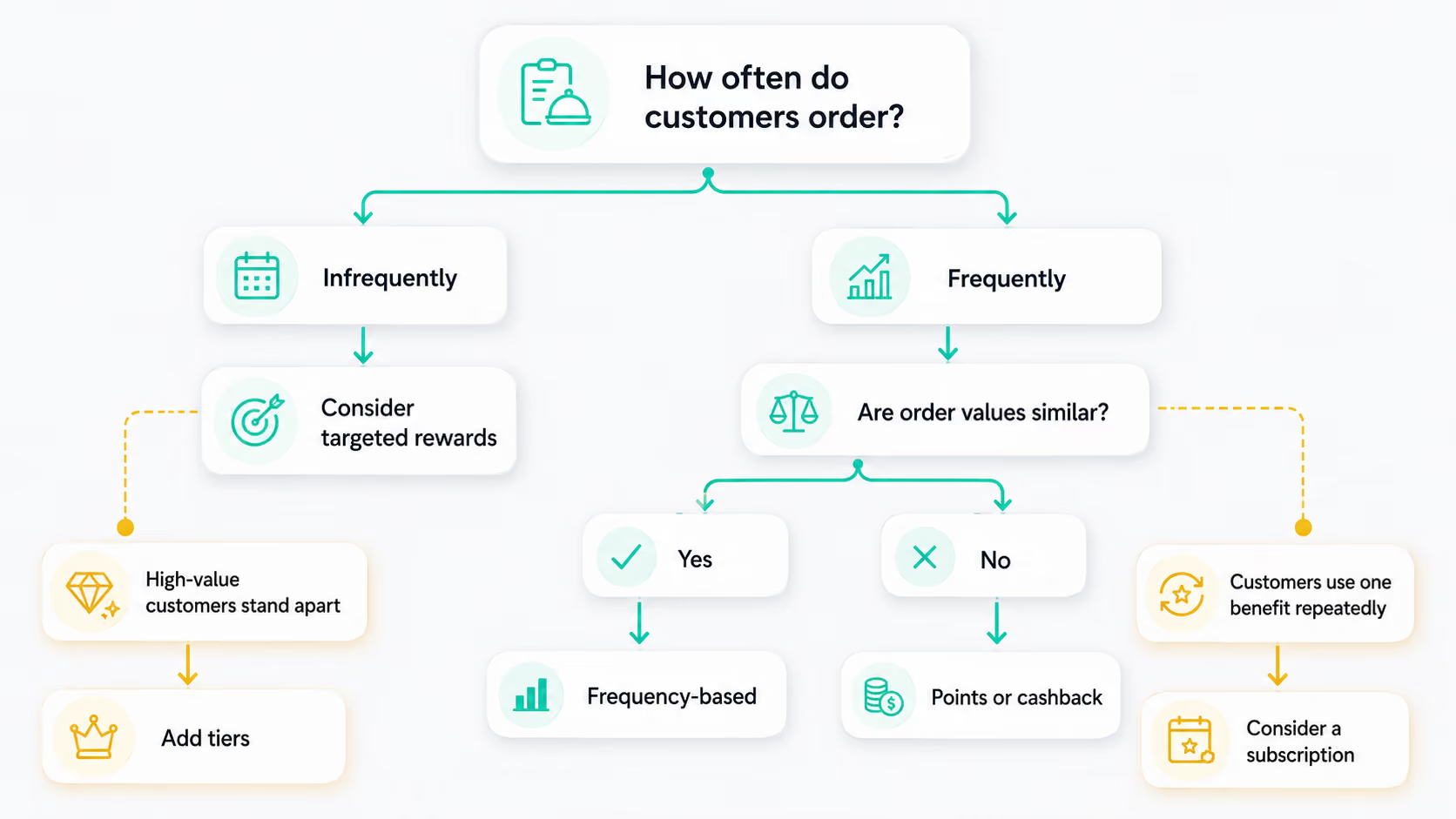
As you can see, there’s clearly no shortage of restaurant loyalty programs to choose from. However, finding the right fit can be difficult. Use the comparison table below to narrow down the best option for you:
Which Loyalty Program Model Fits Your Restaurant Type?
Restaurant type alone doesn’t determine which loyalty model will work best, but it can give you a useful starting point. The table below translates the options covered above into common restaurant formats so you can quickly identify which models are worth evaluating more closely.
How to Design Your Restaurant Loyalty Program
A loyalty program needs three things to work: a clear goal, a benefit customers can realistically access and value, and rules they can understand before joining. Here’s what you need to do:
1. Choose the result you want to achieve
First of all, select one customer behavior you want your restaurant loyalty program to influence, and record how it currently performs. For example:
- Second orders: Let’s assume that at present, 18% of your first-time customers place another order within 60 days. Your goal then becomes to increase this to 24% by offering an attainable reward for their second time.
- Direct orders: If your branded ordering website or app accounts for 35% of member orders, you may aim to raise this to 50% within six months by reserving stronger earning or redemption benefits for direct orders.
These figures give you a baseline for measuring the program later and shape the offer you create.
2. Decide how a customer earns a reward
Before choosing the reward itself, decide what customers need to do to earn it.
Decide what counts toward progress
First, define which purchases or customer actions qualify for your loyalty program. For example, decide whether customers earn progress from:
- Discounted items
- Gift card purchases
- Catering or bulk orders
- Orders below a minimum value
- Third-party marketplace orders
- Taxes, tips, delivery fees, and service charges
These rules determine exactly which purchases help customers move closer to a reward.
Decide how much progress is required
Next, choose what customers need to achieve before they unlock a reward.
Depending on your loyalty model, this could be:
- Spending a certain amount (for example, Spend $100)
- Collecting a number of points (for example, 500 points)
- Completing a number of visits (for example, 10 visits)
- Paying a monthly or annual membership fee (for subscription programs)
The goal is to make the reward feel worthwhile without making it too easy or too difficult to earn.
Check whether the goal is realistic
Finally, compare your earning requirement with how often your customers actually order.
For example:
- If customers typically visit once every three weeks, a 10-visit reward would take about 30 weeks to earn.
- If they visit twice a week, they would reach the same reward in just five weeks.
If customers have to wait too long before earning their first reward, many will stop participating before they ever experience the value of your loyalty program.
Next, check whether the reward makes financial sense
The best loyalty rewards aren't necessarily the most expensive ones—they're the ones that feel valuable to customers while costing relatively little for your restaurant to provide.
Imagine you want to reward customers with a free burger.
Now calculate how much that reward actually costs your business.
Reward Cost Percentage = Actual Cost of Reward ÷ Customer Spending Required
In this example:
$4.00 ÷ $100 = 4%
That means customers feel they've earned a $10 reward, while it only costs your restaurant 4% of the revenue generated to earn it.
Tip: The strongest loyalty rewards create a large difference between perceived customer value and your actual cost. A free dessert, drink, side, or signature appetizer often feels generous to customers while costing significantly less than a blanket percentage discount.
Next, compare what customers think the reward is worth with what it costs you to provide. Suppose you offer a menu item that sells for $9 as the reward, and this is the formula you use to calculate:
Select a reward that customers genuinely value while keeping the cost sustainable as more members begin redeeming it.
3. Define the rules customers need to know
Lastly, set the conditions governing where, when, and how customers can use the reward. You should decide:
- Whether a minimum order applies
- Which items or categories are eligible
- Whether partial redemption is available
- Which locations and ordering channels accept rewards
- Whether rewards can be combined with promotional codes
- Whether customers can use more than one reward per order
- How long points, credits, rewards, and tier status remain valid
Limit exclusions to those needed to manage cost or prevent misuse, such as a minimum order value or a restriction on combining rewards with other promotions. Too many conditions can make a reward difficult to understand and disappointing to redeem for the customer.
How to Integrate Loyalty Programs With Direct Online Ordering Platforms
You’ve already decided what customers earn and how they redeem it. The next task is translating those rules into settings and data flows that your direct online ordering platform can apply to every eligible order. For that, you must follow these steps:
1. Make sure every order reaches the correct loyalty account
Define how customers will identify themselves when ordering through your website or app. Will it be through an account login, email address, or phone number?
Use the same identifier wherever rewards are earned or redeemed. For example, a customer may join your restaurant loyalty program using an email address, then place their next order using a phone number.
Your platform should allow you to merge those profiles without losing their points, rewards, tier status, or order history. Place a sample order and check that it appears under the correct customer account with the expected points, credit, or visit progress.
What a Restolabs customer says: “Overall, we’ve had a very positive experience with Restolabs. While there are things we would change, their ability to integrate easily with our POS and loyalty platforms and process a high number of orders without issues has made it a productive relationship. When issues arise, their customer support quickly resolves problems.” — Weston B, Eli’s Coffee Shop, Illinois, USA
https://www.restolabs.com/testimonials
2. Confirm when progress is added and how rewards are redeemed
Depending on the options available, your direct online ordering platform may add newly earned points, credit, or visit progress to the customer’s account when:
- Payment succeeds
- Your restaurant fulfills the order
- Pickup or delivery is completed
- Your restaurant accepts the order
Adding progress after payment gives customers an immediate update. Waiting until the order is completed reduces the need to reverse progress from rejected or canceled orders. Whichever point you choose, apply it consistently across your website, app, and participating locations.
Next, check how customers use available rewards during checkout. Ideally, they should be able to see:
- Their current balance
- The rewards available for the order
- Any minimum order or item restrictions
- The revised total after applying a reward
For example, a customer with a free-item reward should see which menu items qualify. Once they select one, the reward should be implemented automatically in the order summary.
3. Keep balances and benefits accurate when orders change
Your loyalty platform must receive updated information when you cancel, edit, or refund an order. Here are the steps to take for each:
If a $50 order earns 500 points and $20 is later refunded, the customer should keep only the 300 points earned on the remaining $30.
You should also confirm how your restaurant loyalty program handles points that have already been used before the related order is refunded. The account may carry a negative balance, recover the points from future earnings, or require a manual adjustment.
How to Launch, Promote, and Optimize Your Restaurant Loyalty Program
Once your program is configured, the next challenge is getting customers to notice it, join it, and continue using it after the initial signup. This is where placement and timing matter. Here’s what you should do:
1. Introduce the loyalty program when customers are most likely to join
That could be when they’re already browsing your menu, building an order, or completing a purchase. These are the moments when the benefit feels relevant because they can immediately see how their current order contributes toward it.
For example, instead of placing a general “Join our rewards program” message somewhere on your homepage, you could show a more specific invitation beside the cart, like: “Create an account and earn 180 points from this order.”
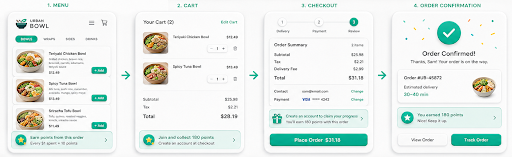
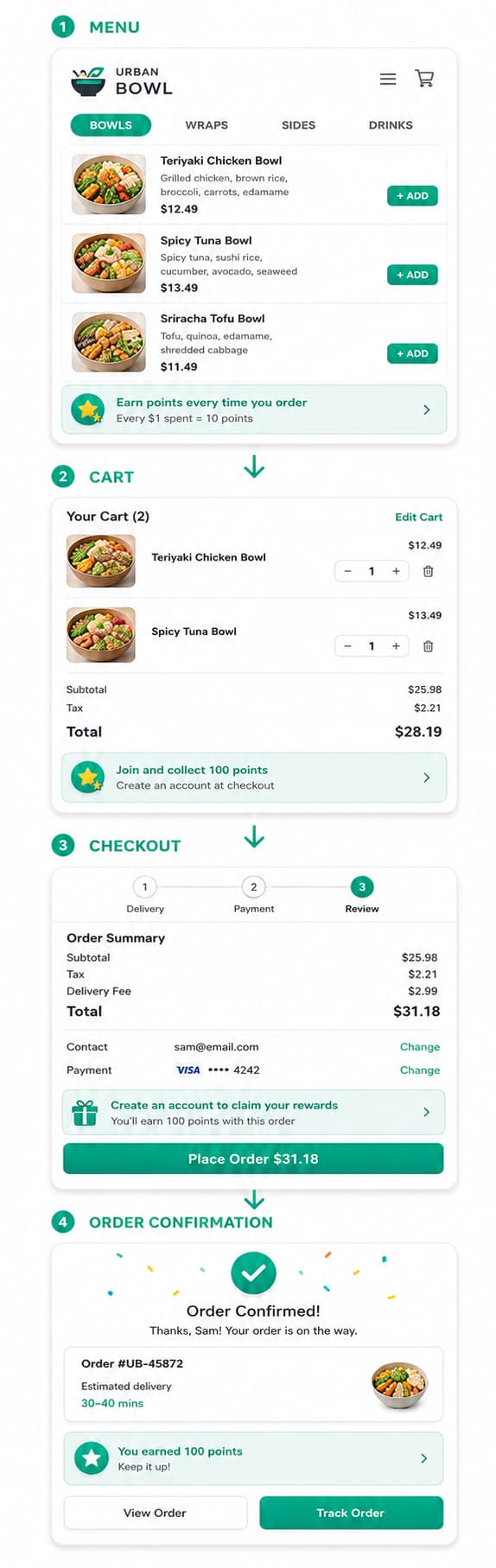
The customer can see what they gain from joining right now, rather than being asked to register for a benefit they may use at some point in the future.
Carry the same idea through the rest of the ordering journey. A first-time customer may see the invitation during checkout, while the confirmation page can offer another opportunity to claim the progress from the order they just placed.
Receipts, packaging, table displays, and QR codes can also direct dine-in or marketplace customers to the same direct-ordering program.
2. Give members a reason to keep participating
After someone enrolls, your communication needs to change. You now have to show the member what they’ve earned, how close they’re to the next benefit, and when they can use it.
Therefore, with every qualifying order, confirm the progress added to the account. A message such as “You earned 120 points and now have 420 of the 500 points needed for your reward” gives the customer a much stronger reason to return than a standard order-confirmation message.

Also, pay attention to the first action after enrollment. When customers join but never complete a qualifying order, the program has gained a member without attracting any meaningful participation.
A follow-up message can remind them what counts, what they can earn, and whether their next direct order will move them toward the reward.
3. Monitor and optimize early program performance
During the first 30 days, track how customers progress from seeing the program to joining, earning, unlocking a reward, and redeeming it. A drop at each stage can point to a different problem.

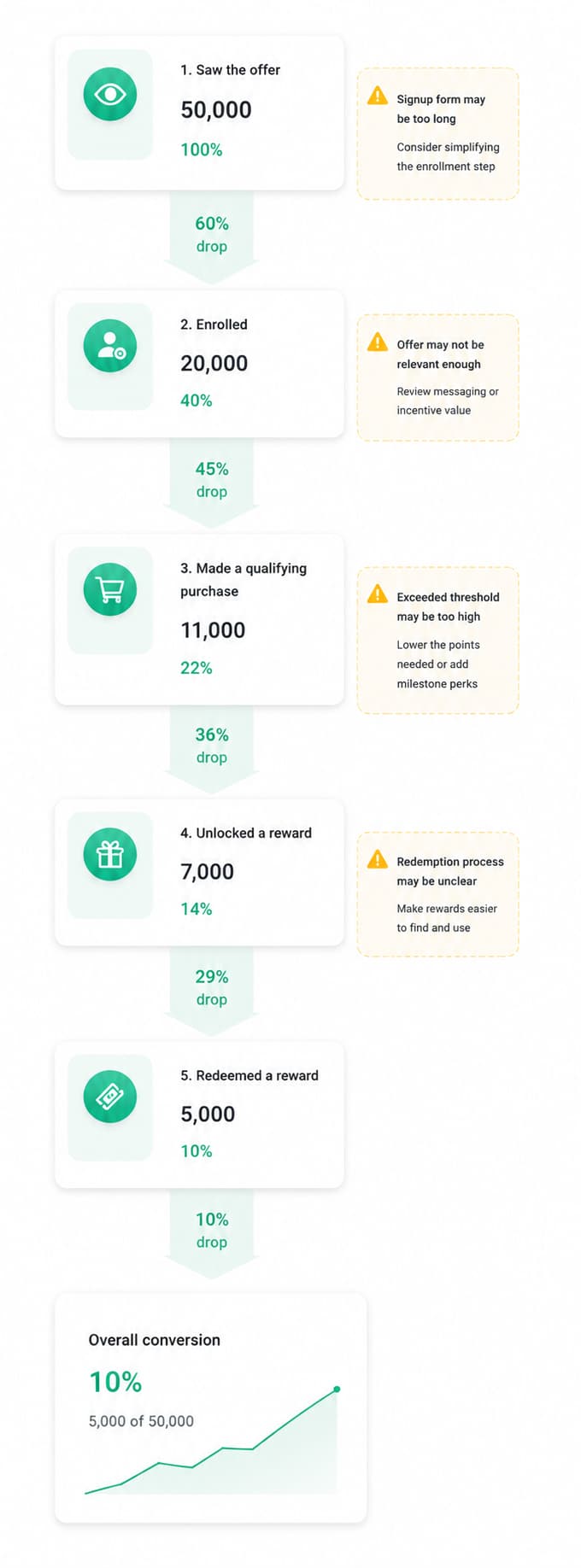
Use the following metrics to separate customer friction from weak program performance:
Make one significant change at a time so you can see what affects the result. If direct-order share remains unchanged, test a stronger earning rate for website and app purchases rather than increasing rewards across every channel.
If members regularly stop before reaching their first reward, shorten the initial threshold before redesigning the entire program.
Start With Where Your Customers Aren’t Coming Back
Before diving into restaurant loyalty programs, review your recent order data and look for a clear break in the customer journey.
For instance, first-time customers may rarely return, regular customers may be ordering less often, or frequent diners may continue using third-party platforms instead of ordering directly.
Select the pattern with the greatest impact on your restaurant. This gives your loyalty program a defined purpose and guides the decisions that follow, including what customers earn, how quickly they reach a reward, and which benefit is most likely to influence their next order.
You can then configure the offer within a direct online ordering platform like Restolabs.
- It’s designed for small to mid-sized restaurants, QSRs, pizzerias, and cafés that want to manage online ordering and loyalty across their websites and mobile apps.
- Restolabs can connect with established POS systems and offers access to 50+ payment integrations, allowing you to work with much of the technology your restaurant already uses.
- It supports app-free QR table ordering, multilingual menus, and centralized controls for restaurants operating across multiple locations.
- You also retain ownership of customer profiles, ordering behavior, item combinations, and lifetime spend data through the dashboard.
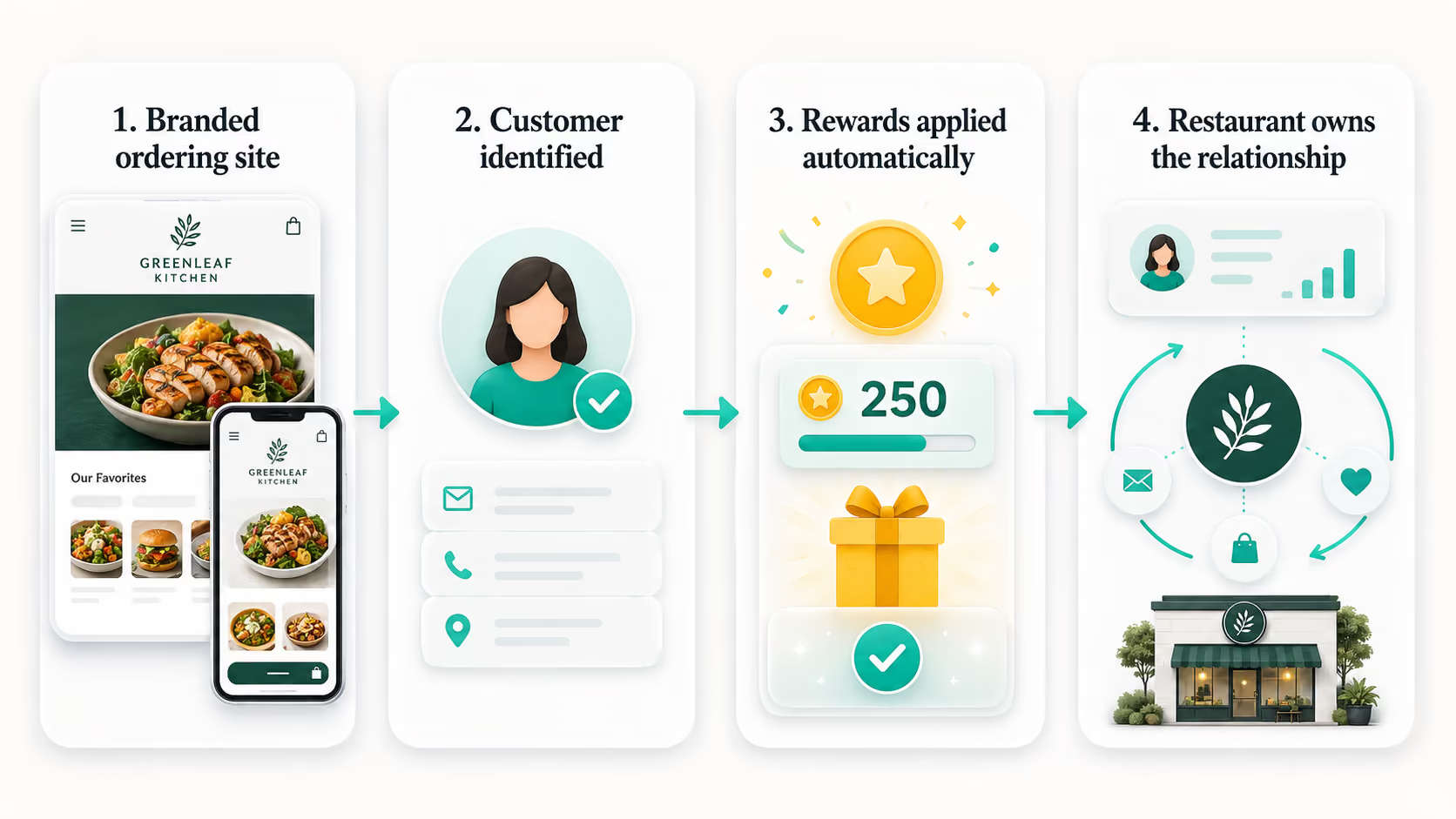
Use those capabilities to strengthen direct-order habits and run a successful loyalty program. Schedule a free demo with Restolabs today.

Sruthi Sekar specializes in brand strategy, growth, and user experience in the hospitality industry. As the driving force behind Restolabs, she helps restaurants harness technology to scale and thrive. With a background in design, branding, and entrepreneurship, she brings a sharp focus on crafting digital experiences that drive real business impact.
Frequently Asked Questions
Yes. Well-planned restaurant customer loyalty programs can increase repeat visits, average order value, and customer retention. They also give restaurants a direct way to understand customer behavior and reward loyal guests. The strongest programs encourage frequent purchases without relying on constant discounts or giving away too much free food.
Start by deciding what you want your own restaurant loyalty program to achieve, such as increasing visit frequency, encouraging direct orders, or raising average order value. Next, choose a loyalty system that works with your POS and online ordering platform. Smaller restaurants can begin with a free program or basic free loyalty tools, while larger operators may need more advanced loyalty tools, automation, and support from their marketing team.
The best incentives are easy to understand, attainable, and relevant to your customers. Popular options include birthday offers, discounts, menu upgrades, free food rewards, and subscription perks such as free delivery or discounted drinks. In points-based restaurant reward programs, members earn points whenever they order and collect points toward a reward. Restaurants can also offer extra rewards, allow members to earn bonus points, or award more points for direct orders, referrals, or purchases during quieter periods.
The best restaurant loyalty programs are simple to join, easy to use, and consistent across in-store and online ordering channels. The best loyalty program for a restaurant depends on its menu, order frequency, average ticket size, and customer habits. High-frequency QSR loyalty programs often use points and instant rewards, while other digital loyalty programs may rely on tiers, personalization, or exclusive access.
Track enrollment, active member rate, redemption rate, visit frequency, average order value, and overall loyalty program participation. You should also measure whether the program keeps customers engaged, encourages customers coming back, and changes purchasing patterns over time. Comparing member and non-member activity will show whether the program is generating additional visits rather than simply rewarding existing behavior.
Keep the earning rules simple, make rewards achievable, and clearly explain the rewards exchange between spending, loyalty points, and available benefits. To make a loyalty program resonate with customers, base rewards on their preferences and purchasing patterns. Customers should understand the value quickly, and customers feel more appreciated when offers reflect what they genuinely order rather than generic promotions.



.jpg)
.jpg)
.jpg)




.webp)

.svg)
.webp)